Natalia’s Tour Tips
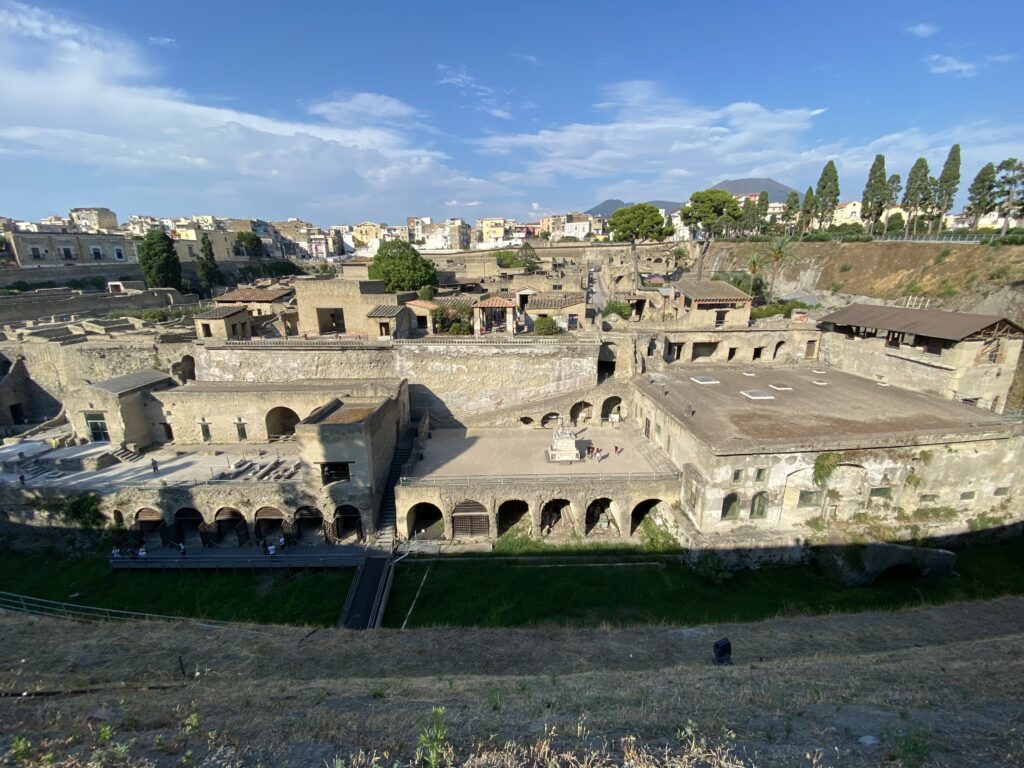
Herculaneum: a remarkably intimate Roman city
Herculaneum is one of the most extraordinary archaeological sites in the world.
Like Pompeii, the ancient city was overwhelmed by the eruption of Mount Vesuvius in AD 79. But the experience here is completely different.
Herculaneum was a smaller, wealthier and more residential town, and the volcanic material that buried it preserved an astonishing amount of detail.
If Pompeii allows you to understand the scale of a Roman city, Herculaneum allows you to look inside it.
How long should a Herculaneum tour last?
2 hours – The Classic Herculaneum Tour
Two hours is the standard length for a guided visit and allows us to explore the essential highlights of the archaeological site without rushing.
We will walk through the ancient streets and discover beautifully preserved houses, mosaics, frescoes, shops and public buildings, while uncovering the stories of the people who lived here almost 2,000 years ago.
It is the ideal option for travellers who want a complete and engaging introduction to Herculaneum.
3 hours – The In-Depth Experience
With three hours, we can go beyond the main highlights and take more time to appreciate the extraordinary details preserved by the eruption.
Herculaneum offers an exceptional opportunity to look closely at Roman architecture and everyday life — from wooden doors and beams to furniture, decorations, mosaics and frescoes.
With more time, we can explore these details without rushing from one building to the next.
What should you bring?
Herculaneum may be smaller than Pompeii, but you will still be walking through an archaeological site with uneven ancient surfaces and areas exposed to the sun.
I recommend bringing:
- Water – especially during the warmer months.
- ID/Passport
- A hat or cap – useful on sunny days.
- Sunscreen – the sun can be strong, particularly in summer.
- A light scarf or foulard – useful for additional sun protection.
- Comfortable shoes – some of the ancient surfaces can be uneven.
- Your camera or smartphone – the preservation of Herculaneum offers extraordinary photographic opportunities.
Visiting Herculaneum with reduced mobility
Herculaneum is an ancient archaeological site, and some areas can be challenging for visitors with reduced mobility because of the original streets, changes in level and archaeological surfaces.
If mobility is a concern, please let me know when booking your private tour.
We can plan the itinerary in advance, identify the most suitable areas and adapt the pace of the visit to make the experience as comfortable as possible.
For families travelling with young children or strollers, planning the route in advance is also recommended.
A private experience, designed around you
This is an exclusive private tour, not a shared experience, led by a dedicated professional, officially licensed local guide.
Our private tours are designed for small groups looking for a high-quality, personal experience.
The itinerary and pace can be adapted according to your interests — whether you are passionate about archaeology, Roman history, architecture, art or simply want to understand what life was like in Herculaneum before the eruption.
My most important tip: choose your guide carefully
Herculaneum may be smaller than Pompeii, but understanding what you are looking at requires context.
A professional guide can help you recognise the details that otherwise look like simply another wall, another mosaic or another ancient street.
For this reason, I strongly recommend booking your experience with a private, officially licensed local guide rather than relying on generic online tours or last-minute offers.
A professional guide provides not only historical knowledge, but also comfort, organisation and peace of mind.
You know who will be accompanying you, how the visit will be organised and what is included.
Most importantly, your guide can adapt the experience to your interests and avoid wasting precious time on a generic itinerary.


 English
  Italiano
  Deutsch
  Français